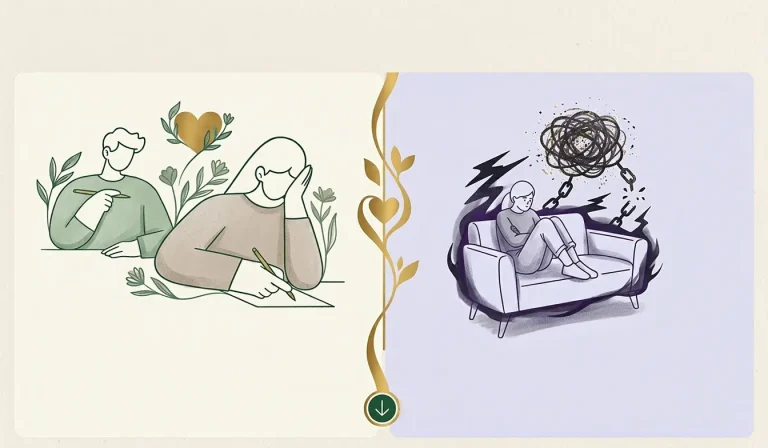
What Does Good Mental Health Actually Look Like? It’s More Than Just Feeling Happy
Ask a room of people to describe a mentally healthy person and you’ll hear a lot of the same words: happy, calm, positive, confident. It’s a pleasant picture, and it’s quietly harmful, because almost nobody matches it for more than an afternoon.
If good mental health meant feeling good, then every grief, every sleepless week, every bout of nerves before a big day would count as a failure. People end up measuring themselves against a standard that doesn’t describe anyone, then feeling worse about falling short of it.
A more accurate picture is less glamorous and more useful. Good mental health isn’t the absence of difficult feelings. It’s what you can do with them. This article explains what that looks like, why it’s better understood as a range than a switch, and which everyday habits support it.
What Good Mental Health Is, in Plain Terms
The World Health Organization describes mental health as a state of well-being in which a person can realise their abilities, cope with the normal stresses of life, work productively, and contribute to their community. It also stresses that mental health is more than the absence of a mental disorder. Not being ill and being well are different things.
In everyday language: you can handle life’s ups and downs, you have relationships that matter, you can function in ways that are important to you, and you can recover when things go wrong.
Notice what’s missing from that definition. There’s no mention of happiness, positivity, or calm.
Why “Just Be Happy” Gets It Wrong
Happiness is one emotion. Mental health is a wider capacity.
A mentally healthy person still feels anger, grief, fear, and boredom. The difference lies in what happens next. They can feel the emotion, make sense of it, and recover without it taking over their life. Learning about emotional regulation can also help readers understand how people recognize and manage difficult feelings.
Chasing constant happiness can even backfire. If every low mood registers as a malfunction, you add shame on top of the original feeling, and shame is a reliable way to make a hard day longer. Research on people who judge their own emotions harshly has linked that habit with poorer emotional outcomes, though as with much of this field the findings are correlational and still being refined.
Mental Health Is a Range, Not a Switch
Many of us picture two boxes: healthy and ill. Reality is closer to a moving scale, and there are actually two scales.
Sociologist and psychologist Corey Keyes proposed what’s often called the dual continua model. In it, mental illness and mental well-being are related but separate dimensions. That has two surprising implications:
• A person with a diagnosed condition can still have good well-being and a meaningful life.
• A person with no diagnosis can still feel empty, stuck, or flat. Keyes called this “languishing.”
Where you sit on either scale shifts with sleep, stress, physical health, grief, money, and support. That’s normal. It isn’t a personal flaw, and it isn’t permanent.
Ten Signs of Good Mental Health
Nobody ticks every box every day. Treat these as a rough guide, not a test.
1. You can name what you feel. “I’m annoyed” or “I’m anxious” beats a vague sense of being off.
2. Bad days pass. Difficult moods come and go instead of settling in for weeks.
3. You can cope with ordinary stress. You may wobble, but you find ways through.
4. You have people you can be real with. Even one or two close connections matter a great deal.
5. You can ask for help. Needing support doesn’t frighten you.
6. You can enjoy things. Not always, but often enough.
7. You can rest without heavy guilt. Downtime doesn’t feel like failure.
8. You can set boundaries. You can say no without a spiral of worry.
9. You have some sense of purpose. It can be small: family, craft, faith, a routine you value.
10. You can recover from setbacks. You bend, then adjust.
What It Looks Like in Real Life
Examples help more than definitions.
• At work: You get critical feedback, feel stung, and still read it calmly the next day.
• In relationships: You disagree with a friend, say so respectfully, and repair afterwards.
• After a loss: You grieve deeply, lean on others, and slowly rebuild a routine.
• During a quiet week: You feel a bit flat but keep eating, sleeping, and seeing people.
What these share is that feelings are present, sometimes strongly, while function and connection continue.
Good vs. Poor Mental Health
| Good mental health | Poor mental health | |
| Emotions | Wide range, can be named and managed | Stuck, overwhelming, or numb |
| Stress | Hard but manageable | Feels unbearable most days |
| Relationships | Connected, able to be honest | Withdrawn or constantly conflicted |
| Daily life | Routines mostly hold | Basic tasks feel too heavy |
| Self-view | Mostly fair and kind | Harsh, hopeless, or worthless |
| Help-seeking | Possible | Feels pointless or shameful |
Most of us land between the columns at different times. That’s ordinary, not alarming.
Emotional, Psychological, and Social Health
These terms overlap and people use them loosely. A simple way to separate them:
• Emotional health is how you recognise and handle feelings.
• Psychological health is how you think, decide, and see yourself.
• Social health is how well you connect with, and can rely on, other people.
Good mental health draws on all three, and a weak spot in one often shows up in the others.
Does Culture Change What “Healthy” Looks Like?
In how it’s expressed, yes. In some cultures people talk openly about emotions. In others, distress is more likely to surface as headaches, tiredness, or stomach problems, and family duty, faith, and community roles shape what counts as normal coping.
That’s why it helps to judge mental health by function, connection, and distress, rather than by whether someone discusses their feelings in one particular style.
Practical Takeaways: Habits That Support Well-Being
Habits aren’t a cure for mental illness, and nobody should be told to exercise their way out of depression. They do build resilience, and they’re worth taking seriously.
• Protect your sleep. Short or irregular sleep reliably worsens mood, focus, and emotional reactivity.
• Move your body. An overview of systematic reviews published in the British Journal of Sports Medicine (Singh et al., 2023) found that physical activity interventions improved symptoms of depression, anxiety, and distress across many groups.
• Stay connected. A short call or a walk with someone counts.
• Limit constant doomscrolling. Notice how your feed leaves you feeling, not how long it holds you.
• Eat regularly and stay hydrated. Skipped meals make irritability worse.
• Spend time outdoors. Even brief daylight helps many people.
• Do something absorbing. Music, cooking, gardening, sport, prayer, or art.
• Check in weekly. Ask: how are my mood, sleep, and energy compared with last month?
If you’re unsure where you stand, tracking mood, sleep, and energy for two weeks makes patterns far easier to see than memory does.
When Mental Health Needs More Than Self-Care
Self-care has limits, and recognising them is itself a sign of good mental health. Consider professional support if sadness, worry, or numbness lasts two weeks or more; if you struggle to work, study, or look after yourself; if you use alcohol or other substances to cope; if sleep or appetite has changed a lot; if you have panic attacks, intrusive thoughts, or constant dread; or if you feel hopeless or think life isn’t worth living.
If you are in immediate danger or thinking about suicide, contact your local emergency number or a crisis line now. In the US, call or text 988. Elsewhere, findahelpline.com lists services by country.
Key Takeaway
Good mental health isn’t a permanent smile. It’s flexibility, connection, and the ability to keep going, and to ask for help, when life gets heavy. Well-being and illness are separate scales, so a person can have a diagnosis and a good life, or no diagnosis and an empty one. The aim isn’t to feel good all the time. It’s to be able to feel what you feel and still find your way back.
FAQ
What is the definition of good mental health?
A state of well-being in which you can cope with normal stress, realise your abilities, work productively, and contribute to your community. It’s more than having no diagnosis.
Is good mental health the same as being happy?
No. Happiness is one emotion. Good mental health includes sadness, anger, and fear, along with the ability to work through them.
Can you have good mental health and still have a mental illness?
Yes. Many people with a diagnosed condition have treatment, support, and meaningful lives. Well-being and illness can exist side by side.
What are the signs of a mentally healthy person?
They recover from setbacks, name their feelings, keep relationships, set boundaries, and ask for help when needed.
How can I improve my mental health?
Start with sleep, movement, and connection, and reduce stressors you can control. If difficulties persist, talk to a doctor or therapist.
How do I know if my mental health is bad?
Look for lasting changes in mood, sleep, energy, concentration, or behaviour that make daily life harder.
Does stress mean I have poor mental health?
Not necessarily. Stress is normal. Concern grows when it’s constant, overwhelming, or affecting your health and relationships.
Conclusion
There’s a freedom in dropping the idea that good mental health should feel good. It lets a hard week be a hard week, instead of a verdict.
The people who seem steadiest are rarely the ones who feel the least. They’re the ones who’ve learned that a feeling can be loud and still pass, that help is a tool and not a confession, and that rest isn’t something you have to earn.
References
- World Health Organization. (2022). Mental health: Strengthening our response (Fact sheet). World Health Organization.
- Keyes, C. L. M. (2002). The mental health continuum: From languishing to flourishing in life. Journal of Health and Social Behavior, 43 (2), 207–222.
- Singh, B., Olds, T., Curtis, R., Dumuid, D., Virgara, R., Watson, A., et al. (2023). Effectiveness of physical activity interventions for improving depression, anxiety and distress: An overview of systematic reviews. British Journal of Sports Medicine, 57 (18), 1203–1209.
- Keyes, C. L. M. (2005). Mental illness and/or mental health? Investigating axioms of the complete state model of health. Journal of Consulting and Clinical Psychology, 73 (3), 539–548.