
What Is Psychology? Definition, Branches, History, and How It Works
Psychology is the scientific study of the mind and behavior, how people think, feel, act, and relate to one another. It covers everything from a single passing thought to the patterns that shape entire relationships and workplaces. This guide walks through the psychology definition in plain language, what the field actually studies, whether it counts as a real science, its major branches, how it developed over time, and why it matters far beyond the therapist’s office.
What Is Psychology?
Psychology is the scientific study of the mind and behavior. In simple terms, the psychology definition refers to how people think, feel, and act, and the reasons behind those thoughts, feelings, and actions.
That single sentence carries more than it looks like. Psychology is defined as a science because it doesn’t just describe behavior, it tries to explain and predict it using evidence, not guesswork. Psychology’s meaning stretches across two connected halves: the mind (thoughts, emotions, memories, beliefs) and behavior (what people actually do, say, and choose). Neither half makes sense without the other.
A quick example makes this concrete. Picture someone who keeps putting off an important task. On the surface, that’s just procrastination. Psychology looks underneath it: the anxiety about failing, the short-term relief of avoidance, the habit loop that keeps reinforcing itself. That’s what psychology is about, connecting an inner experience to an outward action.

In most textbooks, psychology is formally defined as the scientific study of the mind and behavior, a definition broad enough to cover everything from basic research to therapy. This foundational definition is what students usually encounter first in general psychology, before branching into a specific area of the field.
What Does Psychology Study?
Psychology is the study of the mind and behavior, but that description covers a huge amount of ground. What does psychology study, specifically? Broadly, it studies two connected categories: what happens inside a person, and what a person does because of it.
• Mental processes: Thoughts, memory, perception, cognition, learning, motivation, and emotions.
• Observable behavior: Actions, habits, communication, decision-making, and social behavior.
• Personality: The stable patterns that make one person consistently different from another.
• Human behavior in context: How family, culture, environment, and relationships shape the way people act.
Put simply, psychology studies how the human mind drives behavior, whether that’s a child learning to read, a team making a group decision, or someone managing grief. It’s rarely one isolated topic; most real situations involve memory, emotion, and behavior all at once.
This overview is essentially psychology basics, the foundational concepts that every specialized branch later builds on.
What Are the Goals of Psychology?
Almost everything psychologists do fits under four objectives psychology has worked toward since it became a science. These four goals of psychology build on one another, moving from simple observation to real-world application:
• Describe: Observe and record behavior and mental processes as they actually occur, without judgment or interpretation.
• Explain: Identify the underlying causes behind a behavior or mental process, not just the behavior itself.
• Predict: Use patterns from past behavior to anticipate how someone is likely to think, feel, or act in similar situations.
• Change: Apply psychological findings to influence behavior in a positive direction, such as easing anxiety or improving how people learn.
These four goals apply across general psychology as a whole, and they show up just as clearly within each specialized branch covered later in this guide.
Is Psychology a Science?
Yes, psychology is a science. It uses the same core scientific method as fields like biology or chemistry: forming a hypothesis, testing it under controlled conditions, collecting measurable data, and revising conclusions when new evidence appears.
This is where the “is psychology a science” debate usually comes from. Critics argue that thoughts and feelings are subjective and harder to measure precisely than, say, chemical reactions. That’s a fair point, but it doesn’t disqualify psychology from being scientific. Instead, psychologists have built specific tools (standardized tests, controlled experiments, statistical analysis) to measure things that can’t be seen directly, the same way physicists infer the existence of forces they can’t touch.
A good real-world example: cognitive behavioral therapy (CBT), one of the most widely used treatments for anxiety and depression, wasn’t invented by intuition. It came out of decades of controlled research testing which techniques actually changed thought patterns and behavior and which didn’t. That’s what makes psychology a science rather than a set of opinions about human nature.
What Are the Main Branches of Psychology?
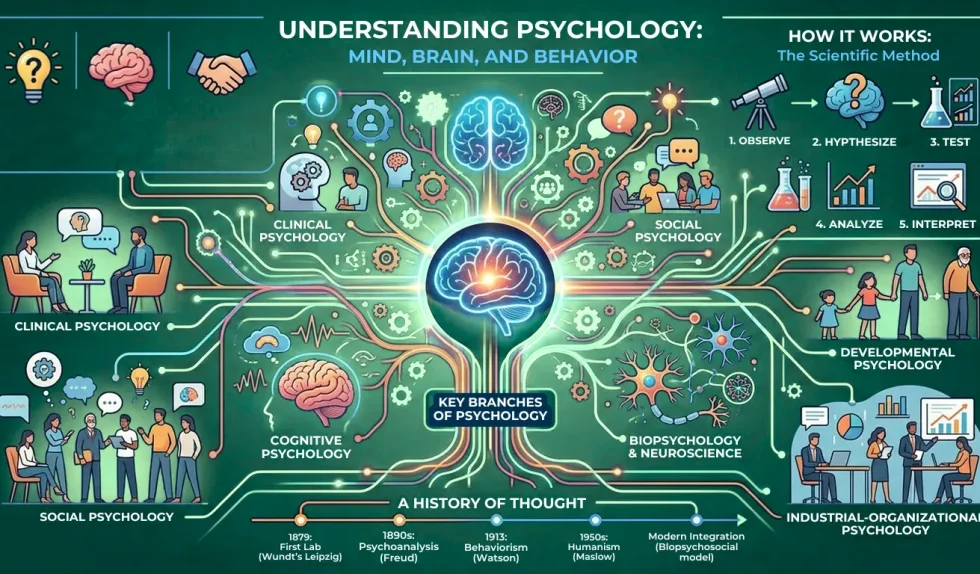
Psychology isn’t one single subject, it’s an umbrella covering dozens of specialized fields of psychology. People often ask about “7 types of psychology,” and while there’s no single official list, most of the field’s work falls under a handful of major branches. Here are the ones that matter most:
Clinical Psychology
Focuses on diagnosing and treating mental health conditions such as anxiety, depression, and trauma, usually through therapy and psychological assessment.
Cognitive Psychology
Studies internal mental processes, memory, attention, problem-solving, language, and decision-making essentially how the mind processes information.
Social Psychology
Examines how other people, group dynamics, and culture influence an individual’s thoughts, emotions, and behavior.
Developmental Psychology
Looks at how people grow and change cognitively, emotionally, and socially across the entire lifespan, from infancy through old age.
Biological Psychology
Connects behavior to the nervous system, brain chemistry, genetics, and hormones, the physical side of the mind.
Personality Psychology
Studies the stable traits, patterns, and individual differences that shape how a person consistently thinks, feels, and behaves.
Behavioral Psychology
Focuses on how behavior is learned and shaped through reinforcement, conditioning, and environmental triggers.
Counseling Psychology
Helps people manage everyday life challenges, stress, and relationship difficulties, often overlapping with clinical work but with a stronger focus on personal growth.
Health Psychology
Studies how psychological factors – stress, beliefs, habits – affect physical health, illness, and recovery.
Industrial-Organizational Psychology
Applies psychological principles to the workplace: hiring, leadership, motivation, and employee performance.
Educational Psychology
Focuses on how people learn, and how teaching methods, motivation, and classroom environments affect that learning.
Applied Psychology
A broad category covering any branch that takes psychological research and puts it to practical use outside the lab from workplaces to courtrooms to sports fields.
Positive Psychology
Studies what helps people and communities thrive well-being, resilience, gratitude, and strengths rather than only what goes wrong.
Sports Psychology
Looks at the mental side of athletic performance: focus, motivation, confidence, and handling pressure.
These branches aren’t walled off from each other. A sports psychologist might draw on cognitive psychology for focus techniques and behavioral psychology for habit building the different types of psychology overlap constantly in practice.
What Do Psychologists Do?
It helps to separate the field from the profession: psychology is the subject, and a psychologist is someone trained to apply it. So, what does a psychologist actually do day to day? It depends heavily on their branch, but common work includes:
• Conducting psychological assessments to understand behavior, cognition, or emotional difficulties
• Providing therapy and counseling for mental health and life challenges
• Designing and running research studies
• Teaching psychology at schools and universities
• Consulting with organizations on workplace behavior, training, or performance
A common point of confusion is the difference between psychology and psychiatry. Psychologists typically hold a doctoral degree, focus on therapy and assessment, and in most places cannot prescribe medication. Psychiatrists are medical doctors who can diagnose and prescribe medication, and they often focus more on the biological side of treatment. The two frequently work together on the same case, each covering a different piece of it.
History and Development of Psychology
Psychology’s history didn’t start with a lab coat, it started with philosophy, and it took centuries to become the evidence-based discipline it is today.
1. Philosophical Roots
Long before psychology existed as a formal subject, ancient thinkers were already asking psychological questions. Greek philosophers like Plato and Aristotle debated where the mind lived and how it related to the body questions that, in different forms, psychologists are still refining today.
2. Psychology Becomes a Scientific Discipline
The turning point came in 1879, when Wilhelm Wundt opened the first laboratory dedicated entirely to psychological research at the University of Leipzig, Germany. Wundt is widely credited as the father of experimental psychology because he was the first to study the mind using controlled, measurable methods rather than pure philosophical debate, this moment marks the beginning of psychology as an independent scientific field.
3. Early Schools of Psychology
Once psychology broke away from philosophy, several competing schools of thought emerged: structuralism (breaking the mind down into basic elements), functionalism (studying what the mind is for), psychoanalysis (Freud’s focus on the unconscious), and behaviorism (which argued psychology should study only observable behavior, not internal thoughts at all).
4. Development of Modern Psychology
By the mid-20th century, the “cognitive revolution” pushed back against strict behaviorism, bringing mental processes like memory and problem-solving back into focus. Around the same time, humanistic psychology, led by thinkers like Carl Rogers and Abraham Maslow, shifted attention toward personal growth and self-fulfillment rather than just dysfunction.
5. Contemporary Psychology
Today’s psychology blends biology, cognition, and social context rather than picking one lens. Neuroscience now shows what’s happening in the brain during a given behavior; positive psychology studies well-being alongside mental illness; and technology has added new territory from AI-assisted research to therapy delivered over video calls.
How Is Psychology Studied?
Psychology earns its place as a science through its research methods. Without them, it would just be opinion. Here’s how psychologists actually gather evidence:
Scientific Method in Psychology
Like any science, psychological research generally follows the same sequence: observe a pattern, form a hypothesis, test it, analyze the results, and refine the theory based on what the data actually shows then repeat.
Experiments
In a psychological experiment, researchers deliberately manipulate one variable (say, hours of sleep) while controlling others, to see its effect on behavior (say, memory recall). This is the main tool for establishing cause and effect rather than just a pattern.
Observation
Researchers watch behavior as it happens naturally, without stepping in for example, studying how children interact on a playground without directing what they do.
Surveys
Self-report questionnaires let psychologists collect data from large groups of people quickly, covering attitudes, habits, or experiences that would be hard to observe directly.
Case Studies
A case study in psychology takes an in-depth look at one person or a small group, often over an extended period. These are especially useful for rare conditions or unusual brain injuries that reveal how the mind normally works.
Correlational Studies
A correlational study measures whether two variables move together for instance, stress levels and sleep quality without claiming that one causes the other. Correlation is a starting clue, not final proof.
Psychological Testing
Standardized psychological tests and assessments including IQ tests, personality inventories, and clinical evaluations give psychologists a consistent way to measure traits or conditions across different people and settings.
Why Is Psychology Important?
Psychology isn’t confined to research papers; its findings quietly shape daily life. Here’s where it shows up:
• Education: Understanding how people learn shapes teaching methods, classroom design, and how students are supported.
• Mental health: Psychology underpins therapy, diagnosis, and treatment for conditions like anxiety, depression, and trauma.
• Relationships: Insight into communication, attachment, and conflict helps people build healthier connections.
• Workplaces: Organizational psychology informs hiring, leadership, motivation, and team performance.
• Decision-making: Psychology explains the biases and shortcuts that quietly steer everyday choices, from spending money to picking a career.
• Everyday life: From managing stress to breaking a bad habit, psychological principles offer practical, evidence-based tools.
That’s really the answer to “why study psychology”: it gives people a working understanding of themselves and the people around them, backed by evidence rather than assumption.
Frequently Asked Questions
What is psychology in simple words?
Psychology, in simple words, is the study of the mind and behavior why people think, feel, and act the way they do.
What is the definition of psychology?
Psychology is defined as the scientific study of the mind and behavior, including thoughts, emotions, and the actions that come from them.
What does psychology study?
Psychology studies mental processes like memory, emotion, and perception, along with observable behavior and how the two influence each other.
What are the 7 types of psychology?
There’s no single official list, but commonly cited major branches include clinical, cognitive, social, developmental, biological, behavioral, and counseling psychology, though the field has many more subfields beyond these.
Is psychology a science?
Yes. Psychology uses the scientific method hypotheses, controlled experiments, and data analysis to study the mind and behavior, which is what qualifies it as a science.
Why is psychology considered a science?
Psychology is considered a science because it relies on systematic, evidence-based research methods rather than opinion, and its theories are tested, measured, and revised based on data.
Who is the father of psychology?
Wilhelm Wundt is widely regarded as the father of experimental psychology, having opened the first dedicated psychology research laboratory in Leipzig, Germany, in 1879.
Why is psychology important?
Psychology is important because it helps explain and improve real areas of life, mental health, education, relationships, workplaces, and everyday decision-making.
What do psychologists study?
Psychologists study the mind and behavior in a specific area of focus, such as mental health, child development, workplace behavior, or how people learn.
What is the difference between psychology and psychiatry?
Psychologists focus on therapy, assessment, and behavior and typically cannot prescribe medication, while psychiatrists are medical doctors who can diagnose, prescribe medication, and treat the biological side of mental health conditions.
What is the difference between psychology and sociology?
Psychology focuses on the individual mind and behavior, while sociology looks at groups, institutions, and societies as a whole, the two often overlap when studying social behavior.
What are the main branches of psychology?
Major branches include clinical, cognitive, social, developmental, biological, personality, behavioral, counseling, health, industrial-organizational, educational, applied, positive, and sports psychology.